Showing posts with label GreenIT. Show all posts

Wednesday, 31 July 2013

Gartner's Hype Cycle Explained


GARTNER - The best research and advisory company I found till date....

Gartner, Inc. (NYSE: IT) is the world's leading information technology research and advisory company.

Gartner's Hype Cycles help technology planners to decide when to invest in that technology. A Hype Cycle is a useful educational tool that:

· Establishes the expectation that most technologies will inevitably progress through the pattern of over-enthusiasm and disillusionment before proving their real value.

· Provides a snapshot of the relative level and pace of maturity of technologies within a certain segment of the IT world, such as a technology area, horizontal or vertical business market, or a certain demographic audience.

· Has a simple and clear message: companies should not invest in a technology just because it is being hyped, nor should they ignore a technology just because it is not living up to early over-expectations.

The Hype Cycle Graphic


Gartner's Hype Curve Breakdown (Source: Gartner)

Lets take some data of 2009 given by Gartner.....we know the current scenario and can see the accuracy of the predictions of this prestigious firm.

Gartner's Hype Cycle for Emerging Technologies in 2009

Just have a look on history that what Gartner said about cloud computing in 2009....

Gartner's Hype Cycle for Cloud Computing in 2009


Gartner's Priority Matrix for Cloud Computing, 2009

The data above says its story and I don't need to explain anymore for our trust on Gartner's analysis and predictions :) :) :)

Saturday, 27 July 2013

FUTURE RESEARCH IMPLICATIONS

An interesting future research objective would be to revisit this CBA when enforceable environmental laws applicable to the ICT sectors are enacted. A change in the European legislative landscape including the Carbon Trading Scheme, and the introduction of effective tax incentives for those enterprises that comply with the EC Code of Conduct requirements, will affect the result of the financial analysis with respect to the quantification and monetary valuation of the environmental benefits. I think it is important to keep an eye on the enactment of similar environmental laws in the US and in emerging countries like India and China because these fast-growing economies are concerning prospects of GHG emission increases. To echo Greenpeace's concerns about cloud computing's possible negative impact on the environment, it may prove of capital importance to dig further into the issue of how big the cloud really is when it comes to electricity consumption and GHG emissions and how big it will become given its rapid growth and given that many major cloud brands refuse to disclose their energy footprint.

Another issue worth investigating further concerns the extent to which European economies are becoming increasingly dependable upon US-centric firms like Google and Microsoft for the procurement of computing resources when the cloud as a utility computing grid becomes ubiquitous.

A corollary business sustainability issue related to the widespread use of cloud computing for the firm's business processes resides in the diffuse control of the Internet as the broadband conduit linking datacenters together, and the relative fragility of its architecture. Lawrence G. Roberts, one of the founders of the Internet, says, in an address to the IEEE organization, that the Internet is broken, and that network routers are too slow, costly, and power hungry (Roberts 2009). Today's Internet traffic is rapidly expanding and also becoming more varied and complex in particular due to an explosion in voice and video traffic. The shift is not without causing problems, he says, even though everybody is using Skype or YouTube today without too much of a hitch, because the packet switching technology at the heart of the Internet's TCP/IP protocol was not designed for that type of application. Packet switching routers around the world are becoming increasingly congested, causing quality of service deteriorations. This may not be perceivable today because the Internet has been grossly over-provisioned by network operators who have deployed mountains of optical fibers during the dot-com era, but at the current rate of growth, cloud computing combined with the massive arrival of the iPad, iPhone, netbooks and other tablet computers, may put the viability of the Internet at risk. The resulting effects would be devastating for those enterprises who rely heavily on cloud computing to perform their business operations.

Tuesday, 9 July 2013

My Thinking Till Now For Cost Benefit Analysis (CBA)

The CBA of the migration project for the software development and test activities at GEC to the AWS cloud shows positive financial results. However, it was not possible to demonstrate that the assumed environmental benefits of cloud computing played a sensitive role there. By migrating parts of the computing resources of the datacenter to the AWS cloud, the financial analysis demonstrated that GEC could achieve significant cost savings in areas of hardware equipment costs, electricity consumption costs for the servers' power and cooling, as well as in user productivity gained from the better effectiveness of the hybrid cloud solution. The financial analysis shows that GEC could obtain a risk-adjusted return on investment (ROI) of 117%, with a payback period of 9 months, by migrating its software R&D's development and test activities to the AWS cloud. However, the initial environmental benefits assumption about cloud computing―resulting from a higher computing efficiency―could not be objectively quantified in the analysis. Failure do to so, can be explained through two main reasons:

Firstly, it is not argued that cloud computing can save billions of kW-hours in energy consumption because cloud providers can squeeze the performance and efficiency of their infrastructures at much higher levels than private datacenters, especially when compared to those of small firms of limited innovation and cash resources. But while the energy efficiency benefits of cloud computing are generally not contested, claiming that cloud computing is a green technology is a totally different story, as reported by a number of ICT practitioners and ONGs like Greenpeace. Despite the fact that some cloud providers are reaching extremely low PUEs, and are also looking to build massive datacenters in places so as to maximize energy efficiency and harness renewable or clean energy, the primary motivation is cost containment, which doesn't necessarily meet environmental and social responsibility objectives. The study showed that while energy efficiency reduces the energy consumption footprint, it is not green if cloud providers are simply looking at maximizing output from the cheapest and dirtiest source of energy available, such as Microsoft's Chicago cloud who supplies power to its datacenter from a coal-burning electricity grid.

Secondly, the current body of environmental legislations that are enacted by governments and regulatory organizations that apply to the ICT sectors are not to a large extent quantifiable in financial terms. This observation I think is coherent with the findings of this study and coherent with the common perception that the economics of green IT are stimulated primarily by the concern of cutting costs in areas of energy-related expenses as well as hardware and maintenance expenses. In other words, “do the right thing for the environment” is not sufficiently rewarded by today's legislations “Energy Policies and Implication”. For example, the EU Emission Trading Scheme (ETS) that regulates the emission of greenhouse gases for the energy sector and other heavy energy consuming industries is not enforceable (yet) to the ICT industry sectors. With regard to energy policies that are of importance to the ICT industry sectors, including the EU Energy Performance of Buildings Directive, the EC Code of Conduct on Data Centers Energy Efficiency, and the Grenelle of the Environment for France, have had, so far, minor to zero financial impacts for the datacenter sector. All this may change in the future, but at the time of this writing it is the current state of business.

Friday, 28 June 2013

Cloud Computing as a Green IT Strategy

Capitalizing on the advance in power of microprocessors and data storage capacity, firms like Amazon and Google are beginning to build massive and highly efficient information processing infrastructures that use the broadband Internet to reach customers. In 2008, Google was said to be operating a global network of about three dozen datacenters around the world loaded with more than 2 millions servers, although this information may be incomplete as Google is very secretive about the location of its datacenters. According to Google’s earnings reports, the company has spent $US1.9 billion on datacenters in 2006, and $US2.4 billion in 2007. Google unveiled four new datacenter projects in 2007. Each has a cost estimate of $US600 million, which will include everything from construction to equipment and computers.47 Both Microsoft and Google have extremely efficient large-scale datacenters; both companies are aiming for an industry-leading PUE of 1.12 in their computing centers (Wheeland 2009). Expanding the use of these services means more incentive to concentrate ICT operations on top-of-the-line facilities, and will continue the shift.


To exemplify the above, an article published in June 2006 by The New York Times (Markoff & Hansell 2006), unveiled Google's project to build the largest and most sophisticated datacenter on the planet near a small town on the banks of the Columbia River, named The Dalles, in North Oregon. Today, the site features three 68,680 square foot windowless warehouses designed to host hundreds of thousands of computers all working together as a single machine to deliver content over the Internet. A kind of information-processing “dynamo” of unprecedented power, comparable to a nuclear power plant for generating electricity, as stated in (Carr 2009b). Since then, The Dalles has become a symbol for the datacenter industry’s growing need for massive amounts of electric power. In its March issue, Harper magazine publishes in (Strand 2008) one Section of the official blueprints of the site plan estimating roughly that once all three server buildings will be operational in 2011, the plant can be expected to demand about 103 megawatts of electricity—enough to power 82,000 homes. The Web, the magazine says, "is no ethereal store of ideas, shimmering over our heads like the aurora borealis. It is a new heavy industry, an energy glutton that is only growing hungrier."


Google is not alone. Microsoft is also investing billions of dollars in very large computing grids, such as its datacenter in Northlake, a suburb of Chicago, which covering 500,000 square feet (46,000 square meters) and costing $US500 million, is one of the biggest, most expansive and sophisticated datacenter on the planet. The entire first floor is designed to be crammed with 200 40- foot (13 meter) each containers, loaded with up to 2,500 servers. To support Northlake's datacenter electricity needs, Microsoft has created three electricity substations that can distribute up to 200 megawatts, that is, as much as a small aluminium melter. Other Internet giants like Yahoo! are also busy building large server farms. In 2008, half a dozen were being built in Quincy in the middle of the Washington state close to the Columbia River. Other massive datacenters are being built in the UK too. For example, Rackspace has built a large datacenter on Slough Estates that will run on renewable energy and will use low-power equipment such as AMD's Opteron processor and HP's c- Class blade servers. The company has partnered with organizations such as NativeEnergy and the International Tree Foundation in the UK to enable carbon-neutral operations through offset programs.


Neither Amazon, Google nor other major providers would officially comment on their datacenters' efficiency levels. However, they argue that thanks to their large customer base, they can make large investments in efficiency innovations, which smaller firms cannot achieve on their own, leading to a continuous maximization of their infrastructure that ultimately benefits both parties. It is commonly reported that a typical PUE for a cloud-based infrastructure is around 1.2 and below, whereas the average datacenter PUE is 2.5 (Wheeland 2009). Furthermore, we see through initiatives like the EC2 Spot Instances program that maximizing the utilization rate of the datacenter is of primary concern since the worst thing for a cloud provider has to maintain an inventory of unused capacity.


Furthermore, cloud computing practices promote worker mobility, reducing the need for office space, buying new furniture, disposing of old furniture, having the office cleaned with chemicals and trash disposed of, and so on. They also reduce the need for driving to work and the resulting carbon dioxide emissions.


But while the environmental energy efficiency benefits of cloud computing are generally not contested, all the discussions about cloud computing being an effective strategy toward green IT actually miss the point, according to an inflammatory report released by Greenpeace in March 2010. This report, "Make IT Green: Cloud Computing and its Contribution to Climate Change," updates and extends some of the research published in 2008 in the Smart 202048 report on how IT contributes to climate change, and finds that the Year of the Cloud is only going to make things worse (Wheeland 2010) and (Greenpeace 2010).


The concern Greenpeace expresses in this report is that despite an increasing focus on PUE, and despite efforts to constantly make computing facilities more efficient, cloud computing is never going to make enough of a dent in greenhouse gas emissions without the involvement of constraining national and supranational regulations. This is because, despite the fact that some providers are reaching extremely low PUEs and are also looking to build their datacenters in places so as to maximize energy efficiency and harness renewable or clean energy, “it is still a tiny slice of the pie of both new and existing datacenters, and the ones that are not using renewable energy or free cooling are the biggest part of the problem”.


Greenpeace alleges in this report that while cloud computing companies are pursuing design and enforcing strategies to reduce the energy consumption of their datacenters, their primary motivation is cost containment, and that the environmental benefits of green datacenter design are generally of secondary importance. Increasing the energy efficiency of its servers and reducing the energy footprint of the infrastructure of datacenters are a must do, but efficiency by itself is not green if you are simply working to maximize output from the cheapest and dirtiest energy source available says Greenpeace in (2010). In this respect, Greenpeace lays out how dirty some of the most renowned cloud provider's biggest datacenters are:


Comparison of significant cloud providers' datacenter fueling energy mix (Graphic courtesy of Greenpeace International)

Google's Dalles facility does the best job, with 50.9 percent renewable energy from hydroelectric power. Microsoft's Chicago facility does the worse job, with 1.1% of renewable energy and 72.8% from coal-burning electricity.

But Greenpeace's concerns about cloud computing's negative environmental impact does not stop here. They argue that with “The arrival of the iPad and growth in netbooks and other tablet computers, the launch of Microsoft’s Azure cloud services for business, and the launch of the Google phone and the proliferation of mobile cloud applications are compelling signs of a movement towards cloud-based computing within the business sector and public consciousness in a way never seen before.”

So another burning question Greenpeace is posing about cloud computing is just how big the cloud really is when it comes to electricity consumption and GHG emissions and how big will it become given its rapid growth, and given that many major cloud brands refuse to disclose their energy footprint.

The Smart 2020 analysis has already forecasted that the global carbon footprint of the main components of the cloud (datacenters and the telecommunications network) would see their emissions grow, on average, 7% and 5% respectively each year between 2002 and 2020, with the number of datacenter servers growing on average 9% each year during this period. The new report brings adjustments to the Smart 2020 report forecast on the electricity demand of the global cloud, highlighting the impact of the projected IT demand and importance of where and what sources of electricity are being used to power Google, Amazon and other cloud-based computing platforms. Table 5 is projection of growth in ICT electricity consumption and GHG emissions by 2020, using a 9% annual growth rate estimated in the Smart 2020 report for datacenters and recent estimate by Gartner for growth in telecommunications of 9.5% a year.

Using the Environmental Protection Agency's Greenhouse Gas Equivalencies Calculator51, I found that 1034 million metric tons of carbon dioxide equivalents (MMTCO2Eq) represent the CO2 emissions from the electricity use of 125 million homes for one year!

Therefore, according to Greenpeace, cloud providers should build new datacenters in areas that provide cleaner energy mixes for their grid, and push regulatory bodies, in the regions where their existing datacenters are housed, to add more renewable energies to the grid.

Saturday, 22 June 2013

Cloud Computing as an IT Efficiency Strategy

The Economist nails down, in a special report on corporate IT entitled “Let IT Rise”, the ascertainment of the current inefficiency state of datacenters worldwide. The Economist claims that 7,000 home-grown designed datacenters in North America alone are notoriously known for their inefficiency and, relays McKinsey and the Uptime Institute findings, that on average, only 6% of server capacity is used. Of even more concern is the assumption that nearly 30% of the servers are no longer in use at all in these datacenters, but no one bothers to remove them. It is claimed that often nobody knows which application runs on which server, and so the method used to find out is to “pull the plug and see how calls”(Siegel 2008, p.3). For years, ICT departments kept adding machines when new applications were needed, which over the years led to a situation known as server sprawl. The illustration below shows the worldwide spending of datacenters since 1996 with a projected increase estimated to $250 billion by 2011.

                                     Datacenter Worldwide Spending (Graphic Courtesy of IDC)

Prior to the economic down-turn of 2009, adding servers was not too much of an issue because entry-level servers were cheap and ever-rising electricity bills were generally charged to the company's facilities budget rather than to the ICT department's budget. But as stated by IDC, this is changing.

Cloud computing as an energy-efficient outsourcing solution deservers some attention. As such, Fleischer and Eibisch (2007) with IDC discuss the business incentives for ICT outsourcing from an increased datacenter efficiency perspective. They report that in 2007 around 50% of companies were still hosting their Web sites and e-business infrastructure internally and that this trend has been consistent over recent years. However, they believe that many companies that do in-house hosting are underestimating the total costs involved in doing so, due mainly to the rising costs of power and cooling and the gradual shift of costs such as power from facilities departments to ICT organizations. This claim is substantiated by a survey conducted by IDC in 2006 showing that 13% of companies' total datacenter operational expenditure went on electricity and that respondents expected that proportion to increase to 20% within a year.

In times of cost-cutting, where companies are striving to reduce fixed costs not directly related to their core businesses, the concern of datacenter inefficiency becomes more stringent. For this reason, IDC believes that many datacenters will be modernized and consolidated, but the cost of modernizing and refitting existing facilities is extremely high and will have a major impact on overall ICT budgets that is beyond the reach of many organizations, including primarily SMBs. Because of that, many enterprises will need to consider fitting-out new datacenter facilities in the near future. A new and more efficient datacenter that consumes less power is a greener datacenter and even more so if further consideration is given to sourcing renewable power, geographical location or reuse of the generated heat, as examples. Considering the source of power generation is also very important as it is possible to reduce a datacenter's power consumption, while still seeing an increase in carbon footprint, if the power source is switched from, say, nuclear to coal.

Numerous studies, including the one conducted by Greenspace46, an Illinois-based vendor of green building supplies, support the claim that cloud customers can save billions of kW-hours in energy consumption, and so, foster the idea that cloud computing is greener than traditional datacenters because providers are able to squeeze the performance and efficiency of their infrastructures at much higher levels of compute resource utilization than individual companies, especially small firms with fewer ICT resources. But whether Cloud Computing is a green technology or not is a totally different question, as you will read in the next post.

Monday, 17 June 2013

Cloud Computing as a Strategy

The potential business benefits of Green IT along the lines of energy saving pressures should make ICT managers look at ways of increasing the efficiency of their operations. In the short term, while these issues need to be addressed, they will remain highly complex. This dilemma should accelerate the move towards the energy-efficiency value proposition of the cloud computing model that presents itself as one of the viable options to reduce much of the risk associated with a datacenter's inefficiency, especially for non-core applications such as Web applications. With regard to the future legislative landscape, it is extremely important that ICT managers begin planning and implementing a methodology to better understand their own carbon footprint and efficiency today to ensure that operations are ready once legislation is approved by the EU and enforced by the member states.


However, Greenpeace observes that the cloud phenomenon may aggravate the overall climate change situation because the collective demand for more computing resources will increase dramatically in the next few years. Even the most efficiently built datacenter with the highest utilization rates will only mitigate, rather than eliminate, harmful CO2 emissions until regulatory measures are taken by governments to incite the generation and use of renewable energy sources in cloud computing infrastructures.

Refer my upcoming two posts to explore more on the above and to read in more detail about 
Cloud Computing as a Green IT Strategy
and 
Cloud Computing as an IT Efficiency Strategy

Thursday, 13 June 2013

Cloud Computing Relationships with Green IT

Perhaps, I should begin the discussion about cloud computing and green IT relationships with the statement that connection between the two concepts is not well established, and as far as cloud computing goes their is a lot “buzz”, confusion, and soon to come, disillusion. An article by Tom Jowitt in Network World illustrates this situation with the findings of Rackspace's Green Survey of 2009 that discloses skepticism about the green benefits of cloud computing, and demonstrates that cost savings and datacenter consolidation are current issues driving the green IT agenda (Jowitt 2009).

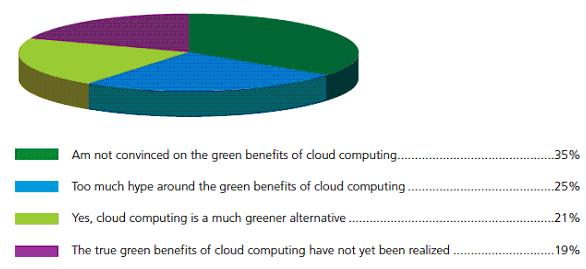
It is reported in the survey that cost savings are proving to be the biggest driver of decisions made about environmentally responsible ICT managers and that companies are still concerned with green initiatives, and are continuing on the track to sustaining and improving their environmentally friendly policies (Rackspace 2009). But in the 2009 edition of the Green Survey, Rackspace added a new question about whether its customers view cloud computing as a greener alternative to traditional computing infrastructure. The result was rather deceptive indicating that only 21% percent agreed that cloud computing was a much greener alternative, against 35% percent that were not convinced on its green benefits, as illustrated in the illustrations below.

Rackspace customer views on cloud computing as a greener alternative to traditional computing infrastructures? (Graphic courtesy of Rackspace)

Rackspace customer views on how cloud computing fit into their environmental initiatives (Graphic courtesy of Rackspace)

Furthermore, only 7% of Rackspace's customers think that cloud computing is critical to their company to become greener, and 46% say that cloud computing is not part of their overall environmental strategy.

Instead, the survey indicates that they are relying on more traditional green initiatives. Seventy one percent have undertaken or are focusing on recycling; 31% on datacenter consolidation; 29% on transportation (car pooling and travel restrictions); 10% on renewable energy; 10% on carbon footprint; and 2% on LEED certification (Rackspace 2009).

In order to better understand why a sizable proportion of Rackspace's customers have the perception that cloud computing is not critical for their company to become greener and that it is not part of their environmental strategy, we need to enter with some detail into what is intended behind the concept of green IT.

Green IT is an umbrella term that Forrester defines in (Washburn & Mines 2009, p.3) as “IT suppliers and their customers reducing the harmful environmental impacts of computing.” Forrester claims in (Washburn & Mines 2009, pp.3-4) that achieving green IT objectives in an organization implies five types of core activities.

Energy efficiency and management: Energy efficiency and management involves reducing energy expenses resulting from the sprawling of server and storage farms, intensive datacenter cooling, and distributed IT assets such as PCs and printers. It is, for most organizations, the major driving force towards Green IT. Energy efficiency can be improved by provisioning more efficient brands of PCs, monitors, power supplies, servers and cooling equipment. Environmental-aware procurement organizations are leaning towards equipment that complies with energy-efficient standards like Energy Star and Electronic, while Product Environment Assessment Tool (EPEAT) helps make the right purchasing decisions. Energy management, in turn, leans towards energy conservation by powering-down IT assets when not in use or by using renewable sources of energy.

Equipment and resource reduction: Reducing the IT equipment footprint by decommissioning and consolidating underutilized equipment reduces energy consumption and proactively curb electronic waste, or e-waste.

Life-cycle and e-waste management: To limit the fast growing proliferation of hazardous materials such as cadmium, lead, and mercury, CIOs should buy less ICT equipment, use less, lengthen the life cycles of ICT assets, and ensure the responsible reuse, recycling, and disposal of IT assets at their end of life.

Support for green corporate initiatives:The new corporate initiatives trend is prompting CIOs to better understand how to provide ICT infrastructure, applications, and expertise to improve the sustainability of business processes and operations outside of ICT, such as support for telecommuting and teleconferencing, paperless billing, building automation, and enterprise wide carbon and energy management.

Governance and reporting: Governance and reporting is viewed as an important process element to green IT, including setting goals, documenting policies, capturing best practices, and reporting progress.