Showing posts with label Cost. Show all posts

Monday, 29 July 2013

Amazon EC2...Amazing Cloud....

Amazon EC2’s simple web service interface allows enterprises to obtain and configure capacity with minimal friction. It provides enterprises with complete control of their computing resources that run on Amazon’s proven computing environment. Amazon EC2 reduces the time required to obtain and boot new server instances to minutes, allowing enterprises to quickly scale capacity, both up and down, as the enterprise's computing requirements change. Amazon EC2 changes the economics of computing by allowing enterprises to pay only for capacity actually used. Amazon EC2 provides developers the tools to build failure resilient applications and isolate themselves from common failure scenarios.

On-Demand Instances Pricing


Amazon EC2 On-DEmand Instances Pricing


Reserved Instances Pricing


Amazon EC2 Reserved Instances Pricing

Spot Instances Pricing

Amazon EC2 Spot Instances Pricing
Spot Instances pricing fluctuates periodically depending on the supply of and demand for Spot Instance capacity. The illustration below takes a snapshot pricing for the EU Region at Wednesday January 13 10:28:06 UTC 2010.

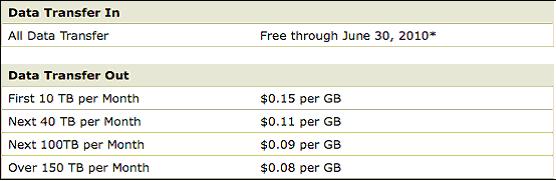
Internet Data Transfer Pricing

The pricing below is based on data transferred "in" and "out" of Amazon EC2.

There is no Data Transfer charge between Amazon EC2 and other Amazon Web Services within the same region (i.e. between Amazon EC2 US West and Amazon S3 in US West). Data transferred between Amazon EC2 instances located in different Availability Zones in the same Region will be charged Regional Data Transfer. Data transferred between AWS services in different regions will be charged as Internet Data Transfer on both sides of the transfer.

Amazon Internet Data Transfer Pricing


Amazon Elastic Block Storage (EBS) Pricing


AWS Import/Export Service

AWS now offers physical data import/export service makes it easy to quickly transfer large amounts of data into and out of the AWS Cloud. It is an economical alternative to sending large volumes of data across the Internet. The AWS Import/Export service allow 2TB of data to be imported or exported globally from AWS S3. With that service, customers can send Amazon a blank storage device and Amazon will copy the contents of one or more Amazon S3 buckets to it before shipping it back. Alternatively, customers can send Amazon a storage device full of data that Amazon will copy it to the S3 buckets of the customer's choice. Customers can use AWS Import/Export for:

· Data Migration
· Offsite Backup
· Direct Data Interchange
· Disaster Recovery

Saturday, 27 July 2013

FUTURE RESEARCH IMPLICATIONS

An interesting future research objective would be to revisit this CBA when enforceable environmental laws applicable to the ICT sectors are enacted. A change in the European legislative landscape including the Carbon Trading Scheme, and the introduction of effective tax incentives for those enterprises that comply with the EC Code of Conduct requirements, will affect the result of the financial analysis with respect to the quantification and monetary valuation of the environmental benefits. I think it is important to keep an eye on the enactment of similar environmental laws in the US and in emerging countries like India and China because these fast-growing economies are concerning prospects of GHG emission increases. To echo Greenpeace's concerns about cloud computing's possible negative impact on the environment, it may prove of capital importance to dig further into the issue of how big the cloud really is when it comes to electricity consumption and GHG emissions and how big it will become given its rapid growth and given that many major cloud brands refuse to disclose their energy footprint.

Another issue worth investigating further concerns the extent to which European economies are becoming increasingly dependable upon US-centric firms like Google and Microsoft for the procurement of computing resources when the cloud as a utility computing grid becomes ubiquitous.

A corollary business sustainability issue related to the widespread use of cloud computing for the firm's business processes resides in the diffuse control of the Internet as the broadband conduit linking datacenters together, and the relative fragility of its architecture. Lawrence G. Roberts, one of the founders of the Internet, says, in an address to the IEEE organization, that the Internet is broken, and that network routers are too slow, costly, and power hungry (Roberts 2009). Today's Internet traffic is rapidly expanding and also becoming more varied and complex in particular due to an explosion in voice and video traffic. The shift is not without causing problems, he says, even though everybody is using Skype or YouTube today without too much of a hitch, because the packet switching technology at the heart of the Internet's TCP/IP protocol was not designed for that type of application. Packet switching routers around the world are becoming increasingly congested, causing quality of service deteriorations. This may not be perceivable today because the Internet has been grossly over-provisioned by network operators who have deployed mountains of optical fibers during the dot-com era, but at the current rate of growth, cloud computing combined with the massive arrival of the iPad, iPhone, netbooks and other tablet computers, may put the viability of the Internet at risk. The resulting effects would be devastating for those enterprises who rely heavily on cloud computing to perform their business operations.

Tuesday, 9 July 2013

My Thinking Till Now For Cost Benefit Analysis (CBA)

The CBA of the migration project for the software development and test activities at GEC to the AWS cloud shows positive financial results. However, it was not possible to demonstrate that the assumed environmental benefits of cloud computing played a sensitive role there. By migrating parts of the computing resources of the datacenter to the AWS cloud, the financial analysis demonstrated that GEC could achieve significant cost savings in areas of hardware equipment costs, electricity consumption costs for the servers' power and cooling, as well as in user productivity gained from the better effectiveness of the hybrid cloud solution. The financial analysis shows that GEC could obtain a risk-adjusted return on investment (ROI) of 117%, with a payback period of 9 months, by migrating its software R&D's development and test activities to the AWS cloud. However, the initial environmental benefits assumption about cloud computing―resulting from a higher computing efficiency―could not be objectively quantified in the analysis. Failure do to so, can be explained through two main reasons:

Firstly, it is not argued that cloud computing can save billions of kW-hours in energy consumption because cloud providers can squeeze the performance and efficiency of their infrastructures at much higher levels than private datacenters, especially when compared to those of small firms of limited innovation and cash resources. But while the energy efficiency benefits of cloud computing are generally not contested, claiming that cloud computing is a green technology is a totally different story, as reported by a number of ICT practitioners and ONGs like Greenpeace. Despite the fact that some cloud providers are reaching extremely low PUEs, and are also looking to build massive datacenters in places so as to maximize energy efficiency and harness renewable or clean energy, the primary motivation is cost containment, which doesn't necessarily meet environmental and social responsibility objectives. The study showed that while energy efficiency reduces the energy consumption footprint, it is not green if cloud providers are simply looking at maximizing output from the cheapest and dirtiest source of energy available, such as Microsoft's Chicago cloud who supplies power to its datacenter from a coal-burning electricity grid.

Secondly, the current body of environmental legislations that are enacted by governments and regulatory organizations that apply to the ICT sectors are not to a large extent quantifiable in financial terms. This observation I think is coherent with the findings of this study and coherent with the common perception that the economics of green IT are stimulated primarily by the concern of cutting costs in areas of energy-related expenses as well as hardware and maintenance expenses. In other words, “do the right thing for the environment” is not sufficiently rewarded by today's legislations “Energy Policies and Implication”. For example, the EU Emission Trading Scheme (ETS) that regulates the emission of greenhouse gases for the energy sector and other heavy energy consuming industries is not enforceable (yet) to the ICT industry sectors. With regard to energy policies that are of importance to the ICT industry sectors, including the EU Energy Performance of Buildings Directive, the EC Code of Conduct on Data Centers Energy Efficiency, and the Grenelle of the Environment for France, have had, so far, minor to zero financial impacts for the datacenter sector. All this may change in the future, but at the time of this writing it is the current state of business.

Saturday, 6 July 2013

Total Economic Impact Methodology

In this dissertation I will apply The Total Economic Impact™ Methodology: A Foundation For Sound Technology Investments by Forrester that is described in (Gliedman 2008) (Erickson & Hughes 2004) and in (Leaver 2009). The Total Economic Impact (TEI) methodology is the product of field practitioners and industry analysts' work with Forrester. The goal of this methodology is to provide a practical and compelling framework that embraces all the critical components of quantified—as opposed to fuzzy—risk and flexibility analysis of a business case template for ICT investments.

Given the increasing sophistication that enterprises have regarding cost analysis related to ICT projects, Forrester's TEI methodology provides a complete picture of the total economic impact of an ICT project by looking at four fundamental financing decision points with associated tools and methodologies for quantification.

Benefits : the TEI methodology calculates the benefit of a technology investment decision in a given use-case scenario. TEI quantifies both tangible and intangible benefits and their dependencies over the period of analysis by identifying and calculating their positive business impacts, such as efficiency or revenue gains over the period of analysis.

Cost : TEI looks to determine the cost of investing in a new initiative, application, or technology by analyzing the change to ICT and business operations caused by the new technology investment compared with the cost of maintaining the current environment over a given period that can include planning, implementation, maintenance, and the associated internal efforts and resources.

Risk : to reduce the marginal error of the estimated benefit and cost, TEI quantifies the impact of risk to establish a more realistic view of likely outcomes by tempering initial benefit estimates to compensate for environmental and technical uncertainty. The result is a risk-adjusted estimate that is most likely a more accurate predictor of the future.

Flexibility : to provide visibility into the investment life cycle, TEI values the future options that are created by the investment decision and estimates the future likely impact of ICT investments by monetizing values of future options created that often result from infrastructure, application architectures, excess capacity and similar platform investments.

The TEI quantification of benefits, cost, risk and flexibility is illustrated in the illustration below:


The Four Elements of TEI: Benefits, Cost, Risk and Flexibility for Financial Analysis (Graphic courtesy of Forrester Research, Inc.)

Benefits Measure Future Positive Impacts of the Project

The TEI methodology applies a rigorous process and best practices to improve accuracy in valuing technology benefits as described in (Gliedman 2008) and (Erickson & Hughes 2004), which consist in:

· Establishing categories of tangible benefits to quantify.

· Establishing quantifiable metrics for each benefit.

· Establishing current baselines and future projections for each metric.

· Establishing an “exchange rate” for the metric.

Friday, 28 June 2013

Cloud Computing as a Green IT Strategy

Capitalizing on the advance in power of microprocessors and data storage capacity, firms like Amazon and Google are beginning to build massive and highly efficient information processing infrastructures that use the broadband Internet to reach customers. In 2008, Google was said to be operating a global network of about three dozen datacenters around the world loaded with more than 2 millions servers, although this information may be incomplete as Google is very secretive about the location of its datacenters. According to Google’s earnings reports, the company has spent $US1.9 billion on datacenters in 2006, and $US2.4 billion in 2007. Google unveiled four new datacenter projects in 2007. Each has a cost estimate of $US600 million, which will include everything from construction to equipment and computers.47 Both Microsoft and Google have extremely efficient large-scale datacenters; both companies are aiming for an industry-leading PUE of 1.12 in their computing centers (Wheeland 2009). Expanding the use of these services means more incentive to concentrate ICT operations on top-of-the-line facilities, and will continue the shift.


To exemplify the above, an article published in June 2006 by The New York Times (Markoff & Hansell 2006), unveiled Google's project to build the largest and most sophisticated datacenter on the planet near a small town on the banks of the Columbia River, named The Dalles, in North Oregon. Today, the site features three 68,680 square foot windowless warehouses designed to host hundreds of thousands of computers all working together as a single machine to deliver content over the Internet. A kind of information-processing “dynamo” of unprecedented power, comparable to a nuclear power plant for generating electricity, as stated in (Carr 2009b). Since then, The Dalles has become a symbol for the datacenter industry’s growing need for massive amounts of electric power. In its March issue, Harper magazine publishes in (Strand 2008) one Section of the official blueprints of the site plan estimating roughly that once all three server buildings will be operational in 2011, the plant can be expected to demand about 103 megawatts of electricity—enough to power 82,000 homes. The Web, the magazine says, "is no ethereal store of ideas, shimmering over our heads like the aurora borealis. It is a new heavy industry, an energy glutton that is only growing hungrier."


Google is not alone. Microsoft is also investing billions of dollars in very large computing grids, such as its datacenter in Northlake, a suburb of Chicago, which covering 500,000 square feet (46,000 square meters) and costing $US500 million, is one of the biggest, most expansive and sophisticated datacenter on the planet. The entire first floor is designed to be crammed with 200 40- foot (13 meter) each containers, loaded with up to 2,500 servers. To support Northlake's datacenter electricity needs, Microsoft has created three electricity substations that can distribute up to 200 megawatts, that is, as much as a small aluminium melter. Other Internet giants like Yahoo! are also busy building large server farms. In 2008, half a dozen were being built in Quincy in the middle of the Washington state close to the Columbia River. Other massive datacenters are being built in the UK too. For example, Rackspace has built a large datacenter on Slough Estates that will run on renewable energy and will use low-power equipment such as AMD's Opteron processor and HP's c- Class blade servers. The company has partnered with organizations such as NativeEnergy and the International Tree Foundation in the UK to enable carbon-neutral operations through offset programs.


Neither Amazon, Google nor other major providers would officially comment on their datacenters' efficiency levels. However, they argue that thanks to their large customer base, they can make large investments in efficiency innovations, which smaller firms cannot achieve on their own, leading to a continuous maximization of their infrastructure that ultimately benefits both parties. It is commonly reported that a typical PUE for a cloud-based infrastructure is around 1.2 and below, whereas the average datacenter PUE is 2.5 (Wheeland 2009). Furthermore, we see through initiatives like the EC2 Spot Instances program that maximizing the utilization rate of the datacenter is of primary concern since the worst thing for a cloud provider has to maintain an inventory of unused capacity.


Furthermore, cloud computing practices promote worker mobility, reducing the need for office space, buying new furniture, disposing of old furniture, having the office cleaned with chemicals and trash disposed of, and so on. They also reduce the need for driving to work and the resulting carbon dioxide emissions.


But while the environmental energy efficiency benefits of cloud computing are generally not contested, all the discussions about cloud computing being an effective strategy toward green IT actually miss the point, according to an inflammatory report released by Greenpeace in March 2010. This report, "Make IT Green: Cloud Computing and its Contribution to Climate Change," updates and extends some of the research published in 2008 in the Smart 202048 report on how IT contributes to climate change, and finds that the Year of the Cloud is only going to make things worse (Wheeland 2010) and (Greenpeace 2010).


The concern Greenpeace expresses in this report is that despite an increasing focus on PUE, and despite efforts to constantly make computing facilities more efficient, cloud computing is never going to make enough of a dent in greenhouse gas emissions without the involvement of constraining national and supranational regulations. This is because, despite the fact that some providers are reaching extremely low PUEs and are also looking to build their datacenters in places so as to maximize energy efficiency and harness renewable or clean energy, “it is still a tiny slice of the pie of both new and existing datacenters, and the ones that are not using renewable energy or free cooling are the biggest part of the problem”.


Greenpeace alleges in this report that while cloud computing companies are pursuing design and enforcing strategies to reduce the energy consumption of their datacenters, their primary motivation is cost containment, and that the environmental benefits of green datacenter design are generally of secondary importance. Increasing the energy efficiency of its servers and reducing the energy footprint of the infrastructure of datacenters are a must do, but efficiency by itself is not green if you are simply working to maximize output from the cheapest and dirtiest energy source available says Greenpeace in (2010). In this respect, Greenpeace lays out how dirty some of the most renowned cloud provider's biggest datacenters are:


Comparison of significant cloud providers' datacenter fueling energy mix (Graphic courtesy of Greenpeace International)

Google's Dalles facility does the best job, with 50.9 percent renewable energy from hydroelectric power. Microsoft's Chicago facility does the worse job, with 1.1% of renewable energy and 72.8% from coal-burning electricity.

But Greenpeace's concerns about cloud computing's negative environmental impact does not stop here. They argue that with “The arrival of the iPad and growth in netbooks and other tablet computers, the launch of Microsoft’s Azure cloud services for business, and the launch of the Google phone and the proliferation of mobile cloud applications are compelling signs of a movement towards cloud-based computing within the business sector and public consciousness in a way never seen before.”

So another burning question Greenpeace is posing about cloud computing is just how big the cloud really is when it comes to electricity consumption and GHG emissions and how big will it become given its rapid growth, and given that many major cloud brands refuse to disclose their energy footprint.

The Smart 2020 analysis has already forecasted that the global carbon footprint of the main components of the cloud (datacenters and the telecommunications network) would see their emissions grow, on average, 7% and 5% respectively each year between 2002 and 2020, with the number of datacenter servers growing on average 9% each year during this period. The new report brings adjustments to the Smart 2020 report forecast on the electricity demand of the global cloud, highlighting the impact of the projected IT demand and importance of where and what sources of electricity are being used to power Google, Amazon and other cloud-based computing platforms. Table 5 is projection of growth in ICT electricity consumption and GHG emissions by 2020, using a 9% annual growth rate estimated in the Smart 2020 report for datacenters and recent estimate by Gartner for growth in telecommunications of 9.5% a year.

Using the Environmental Protection Agency's Greenhouse Gas Equivalencies Calculator51, I found that 1034 million metric tons of carbon dioxide equivalents (MMTCO2Eq) represent the CO2 emissions from the electricity use of 125 million homes for one year!

Therefore, according to Greenpeace, cloud providers should build new datacenters in areas that provide cleaner energy mixes for their grid, and push regulatory bodies, in the regions where their existing datacenters are housed, to add more renewable energies to the grid.

Saturday, 22 June 2013

Cloud Computing as an IT Efficiency Strategy

The Economist nails down, in a special report on corporate IT entitled “Let IT Rise”, the ascertainment of the current inefficiency state of datacenters worldwide. The Economist claims that 7,000 home-grown designed datacenters in North America alone are notoriously known for their inefficiency and, relays McKinsey and the Uptime Institute findings, that on average, only 6% of server capacity is used. Of even more concern is the assumption that nearly 30% of the servers are no longer in use at all in these datacenters, but no one bothers to remove them. It is claimed that often nobody knows which application runs on which server, and so the method used to find out is to “pull the plug and see how calls”(Siegel 2008, p.3). For years, ICT departments kept adding machines when new applications were needed, which over the years led to a situation known as server sprawl. The illustration below shows the worldwide spending of datacenters since 1996 with a projected increase estimated to $250 billion by 2011.

                                     Datacenter Worldwide Spending (Graphic Courtesy of IDC)

Prior to the economic down-turn of 2009, adding servers was not too much of an issue because entry-level servers were cheap and ever-rising electricity bills were generally charged to the company's facilities budget rather than to the ICT department's budget. But as stated by IDC, this is changing.

Cloud computing as an energy-efficient outsourcing solution deservers some attention. As such, Fleischer and Eibisch (2007) with IDC discuss the business incentives for ICT outsourcing from an increased datacenter efficiency perspective. They report that in 2007 around 50% of companies were still hosting their Web sites and e-business infrastructure internally and that this trend has been consistent over recent years. However, they believe that many companies that do in-house hosting are underestimating the total costs involved in doing so, due mainly to the rising costs of power and cooling and the gradual shift of costs such as power from facilities departments to ICT organizations. This claim is substantiated by a survey conducted by IDC in 2006 showing that 13% of companies' total datacenter operational expenditure went on electricity and that respondents expected that proportion to increase to 20% within a year.

In times of cost-cutting, where companies are striving to reduce fixed costs not directly related to their core businesses, the concern of datacenter inefficiency becomes more stringent. For this reason, IDC believes that many datacenters will be modernized and consolidated, but the cost of modernizing and refitting existing facilities is extremely high and will have a major impact on overall ICT budgets that is beyond the reach of many organizations, including primarily SMBs. Because of that, many enterprises will need to consider fitting-out new datacenter facilities in the near future. A new and more efficient datacenter that consumes less power is a greener datacenter and even more so if further consideration is given to sourcing renewable power, geographical location or reuse of the generated heat, as examples. Considering the source of power generation is also very important as it is possible to reduce a datacenter's power consumption, while still seeing an increase in carbon footprint, if the power source is switched from, say, nuclear to coal.

Numerous studies, including the one conducted by Greenspace46, an Illinois-based vendor of green building supplies, support the claim that cloud customers can save billions of kW-hours in energy consumption, and so, foster the idea that cloud computing is greener than traditional datacenters because providers are able to squeeze the performance and efficiency of their infrastructures at much higher levels of compute resource utilization than individual companies, especially small firms with fewer ICT resources. But whether Cloud Computing is a green technology or not is a totally different question, as you will read in the next post.

Monday, 17 June 2013

Cloud Computing as a Strategy

The potential business benefits of Green IT along the lines of energy saving pressures should make ICT managers look at ways of increasing the efficiency of their operations. In the short term, while these issues need to be addressed, they will remain highly complex. This dilemma should accelerate the move towards the energy-efficiency value proposition of the cloud computing model that presents itself as one of the viable options to reduce much of the risk associated with a datacenter's inefficiency, especially for non-core applications such as Web applications. With regard to the future legislative landscape, it is extremely important that ICT managers begin planning and implementing a methodology to better understand their own carbon footprint and efficiency today to ensure that operations are ready once legislation is approved by the EU and enforced by the member states.


However, Greenpeace observes that the cloud phenomenon may aggravate the overall climate change situation because the collective demand for more computing resources will increase dramatically in the next few years. Even the most efficiently built datacenter with the highest utilization rates will only mitigate, rather than eliminate, harmful CO2 emissions until regulatory measures are taken by governments to incite the generation and use of renewable energy sources in cloud computing infrastructures.

Refer my upcoming two posts to explore more on the above and to read in more detail about 
Cloud Computing as a Green IT Strategy
and 
Cloud Computing as an IT Efficiency Strategy

Sunday, 26 May 2013

Cloud Computing Benefits


The main economic appeal of cloud computing relies on its usage-based pricing model, often described as “converting capital expenses (CAPEX) to operating expenses (OPEX). Usage-based pricing is different from renting in that renting a resource involves paying a negotiated fee to have the resource available over a period of time, whether or not the resource is actually used. Usagebased pricing or pay-as-you-go pricing involves metering usage and charging fees based on a finegrained usage basis, independently of the time period over which the usage occurs. With Amazon EC2 for example, it is possible to buy computing resources by the hour and storage by the GB. In addition, hours purchased can be consumed non-uniformly in that 100 server-hours purchased can be used fully on the same day of purchase, the day after or at some later time.
Given the economics of cloud computing and the new business models emerging around the delivery of cloud-based services, new applications can be created and delivered at a radically lower cost compared to conventional approaches. As such, industry analysts and ICT practitioners have agreed upon several major benefit forces that should drive the adoption of the cloud.

Collaboration and Community Computing Benefits
As the globalization trend continues, distributed work has become an everyday reality in large organizations. Many existing on-premises applications were originally designed to support employees in same-time, same-place working styles. By contrast, cloud-based productivity tools (for example, Google Apps, Microsoft Office Live Workspace, Intuit’s QuickBase, Facebook) are inherently collaborative and accessible anywhere, including from home. Community computing and collaboration in the cloud brings benefits that are not easily attainable with local computing, such as the detection of distributed denial of service attacks (DdoS) or spams, as cloud platforms that have a wide visibility on the Internet traffic would detect the onset of an attack more quickly and accurately than any local threat detector.

Cloud Computing Costs
Doing like-for-like comparisons between cloud computing and in-house datacenters to run an enterprise business application is a difficult task because it is easy to neglect many of the indirect and hidden costs incurred by operating a datacenter. In fact, there are many arguments and counterarguments surrounding the total cost of ownership (TCO) of hosting in-house compared with using cloud-based services. This is because each organization has its own capital and operational cost structures and its own break-even point, but IDC in argue that most companies, with relatively standard ICT and Web deployments, will achieve lower TCO by using a managed hosting service than by hosting in self-owned and managed facilities. However, a simple comparison of costs for self-owned versus hosted facilities is typically not possible, even for small companies, due to the large number of indirect and hidden costs20 affecting in-house operations that are overlooked.
In support of this statement, IDC argues that “too many companies inappropriately compare the headline costs of in-house operations and managed services when they evaluate the two side-by-sides, such as the capital cost of servers versus monthly recurring fees. The range of costs necessary to run a decent-quality hosting operation in-house is wider than many companies appreciate, and in house cost cutting can be illusory, creating more in risk than it saves in cost.”
To help out with this issue, Amazon developed in the “Economics of the AWS cloud vs. Owned ICT Infrastructure” a comparative analysis of several direct and indirect costs entailed by owning the facility versus using the AWS cloud that will be used hereafter. In this Section, I will strive to sum up all the direct and indirect costs that apply to operating a self-owned datacenter and how they compare to using cloud-based managed services. This outline will be used hereafter as a calculation basis for TCO of the reference use case.
Operating a self-owned datacenter incurs a number of tangible asset's capital or lease costs and other landlord fees, as well as personnel costs that broadly divide into three categories:
·        Datacenter facility costs that include: building maintenance and upkeep, fit-out costs, technical space maintenance and refurbishment, two or more fiber ducts and fiber services to the building, power plant, backup power generators, fuel storage, chillers, physical security systems (access control, CCTV, security presence, etc.), fire suppression, racks, cabling, and so on. To be included are business continuity redundancy for most of these components, and insurance for all of them.
·        Computing equipments costs that include: depreciation, planned life-cycle replacement, unplanned replacement, backup/hot swap, spare parts inventory (onsite or with supplier), power and cooling costs, software licenses, system monitoring, system security (IDS, email security, DDoS mitigation, etc.)
·        Personnel costs that include: salaries and related overheads of facilities and security staff to operate the physical datacenter as well as of ICT staff to manage the technical environment; cover for staff absence; attrition costs; training; staff facilities.
This is only a subset of the costs a company necessarily incurs in operating its own hosting operations. While many companies, depending on the scale of their operations, make do without some of these components, they are typically incurring risk in return for the cost saving (for example, by cutting back on redundancy, or not deploying a DDoS capability, or under-resourcing the operation in staff terms). A company that uses a managed hosting service will still pay these costs, but the maim assumption about cloud computing's cost-saving opportunities discussed so far is that these costs are shared across all customers of the service provider and, through the economies of scale the hosting provider can achieve, the customer will pay only a fraction of the amount for the in-house operations equivalent.

Conclusion
I think that for most organizations, outsourcing to the cloud should reduce risks and hence costs. The cost elements outlined above all present risk as well as cost to an organization in terms of service disruption resulting in lost orders. Many companies operate internal ICT SLAs, but in the face of a major disruption affecting operations, internal SLAs are effectively worthless. An SLA from an external service provider would typically not cover the cost of lost business or customer dissatisfaction, but can go some way to mitigating the financial impact. More significantly, if stringent enough, the disruption should act as a major incentive for the service provider to fix problems quickly and well. A strong SLA does not nullify risks, but will reduce the financial impact by ensuring quick problem resolution and a level of loss buffering.
Cloud computing is still at an early stage. Therefore, to a significant extent, its technological and business models are as yet unproven. Cloud computing is not necessarily for everyone, nor for any type of application. It is probable though that data security and privacy compliance concerns will prevent a rapid adoption of public cloud solutions in heavy regulated industries, and in many global companies that operate in multiple jurisdictions as stated by Gartner in (Logan 2009). That is why, a company considering moving applications to the cloud must be conscious of their security policies and regulation compliance constraints. Beyond that, I believe that issues around data security and privacy risks in the cloud have been overly emphasized. It is also the opinion of several field experts, who talked at the Kuppinger Cole37 and Cloud Slam 2010 virtual conferences on cloud computing and security I had the opportunity to attend.
There seems to be a consensus around the idea that cloud computing is not inherently insecure or even less secure than traditional ICT. The cloud way may even be more secure than many poorly managed information systems where traditional ICT is incapable of providing the same level of expertise and control on their production systems for reasons as diverse as insufficient staff, limited budget for training and hiring top-of-the-line security experts. As a matter of fact, internal ICT teams can hardly compete with the budget and level of expertise carried out by the big cloud computing vendors to effectively secure their infrastructure from a physical and logical standpoint. In addition, it should be well understood that companies are always responsible —irrespective of whether their data resides in the cloud or not—vis a vis their legal obligations. Therefore, what a company needs to determine is whether or not it can protect, produce and consume sensitive data in the cloud with the same level of security and regulatory compliance as it does internally. Companies wishing to use cloud-based services should ascertain that their provider can meet their requirements and, if so, at what costs if any. Meeting security and compliance requirements can be onerous and expensive for both parties. Litigious relations are often a direct result of not properly addressing the responsibilities of all parties in the contract. Therefore, any hosting business relationships should clearly state what jurisdiction applies to the hosting contract. Cloud hosting providers should honor the security and compliance requirements of their customers, and provide transparent answers to inquiries around those questions.
It should be clearly stated that the responsibility to deal lawfully with corporate data, whether it be in the cloud or not, is not the responsibility of the cloud provider. It is always the responsibility of the company to protect the data it produces, no matter where data is located. In other words, the processes used to deal with the legal complexity of managing data should not be different in the cloud than in a self-owned datacenter. A company must know what it is doing in the cloud by first creating its security and regulatory compliance processes internally, and then ensuring that they can be carried equally by the provider or themselves to the cloud.
Finally, CEOs and CIOs need to understand that cloud computing requires new policies and new controls because it may give rise to new ICT risks that can have an operational and even strategic impact on the enterprise's efficiency and effectiveness. Adopting cloud computing to externalize computing resources poses the question of ascertaining opportunities versus operational and strategic risks.

Saturday, 27 April 2013

Part3 - Cloud Computing Cost-Benefit Analysis Assessing Green IT Benefits

DESCRIPTION
The cost-benefit analysis (CBA) is done for the ICT team of the Engineering Center of (****NAME HIDDEN****)Corp. The project under consideration consists in evaluating the business benefits of using the Amazon Web Services (AWS) public cloud4 for the software development, test and quality assurance (QA) customary tasks of GEC. As observed by a number of field practitioners, software development and test/QA ICT service delivery functions constitute an interesting use case for cloud computing, because it allows software R&D organizations to develop and test applications without having to build and maintain a large datacenter infrastructure.
According to (Syntec 2010, p.7), software development, test and quality assurance (QA) is one of those application types that can best leverage the benefits of the cloud and is easiest to deliver, as shown in the following illustration.

CIO.com online magazine in (Golden 2009b) and in (Golden 2009a) argues that development and test in the cloud makes sense for a number of reasons that are outlined below.
Companies devote the highest percentage of their ICT budget to keeping vital business applications up and running. As a result, development and test procurement of computing resources is often underfunded, leading to poor R&D efficiency and effectiveness.
Development and test (including QA use of resources) is spiky in nature, leading IBM Research in (Rosenberg 2010) to observe that the average enterprise ICT department may devote up to 50 percent of its datacenter infrastructure to development and test, and that up to 90 percent of the available test infrastructure may remain idle at certain points in time. By its very nature, development and test is spiky because a developer will write code, test it out, and will move to other tasks such as design reviews, whiteboard discussions, and so on. Similarly, QA teams make a non-linear use of computing resources for reliability, performance and scalability testing that surges when an alpha release is made available. At times like these, it seems that there are never enough servers to go around.
Development and test teams are often hindered in their attempts to access a productionlike quality environment because it is too costly to replicate and maintain a productionlike infrastructure setup and topology. This issue is particularly acute when testing out how well an application responds to load and stress tests. This means that assessing how well an application behaves in production (i.e., performance, reliability, request latency and throughput) is difficult or impossible to evaluate in constrained environments. Also, many of the most important bugs only surface under heavy load conditions, meaning that these bugs aren't found during development and testing, and that they will surface when deployed in production where it is most costly to fix them.
The datacenter's operations staffs don’t want development and testing to affect production systems. Putting development and testing into the production infrastructure, even if quarantined via VLANs, holds the potential of affecting production applications throughput, an anathema to operations groups. Consequently, development and test groups are often hindered in their attempts to access a production-like environment.

Part2 - Cloud Computing Cost-Benefit Analysis Assessing Green IT Benefits


Motivations
Both cloud computing and green IT topics discussed in this dissertation address two of the most important epochal challenges and business opportunities of our time.
·        Cloud computing represents a paradigm shift that has the potential to disrupt the overall industry by displacing the traditional on-premises datacenter computing style toward a cloud-based computing style delivered as a service over the Internet, where company business processes should gain in flexibility and cost. This prospect is dizzying, but ultimately a very inspiring innovation and technology management business topic.
·        Understanding to what extent cloud computing can help mitigate the devastating effects of global warming through a reduction of the ICT industry carbon footprint, and how businesses can benefit from it, is yet another most inspiring business management topic.
Here is why:
Operating system and middleware software vendors like Microsoft and Sun Microsystems, perceive cloud computing as a disruptive innovation to their business as it is accelerating the software commoditization trend that started in the nineties with the open-source software phenomenon - such as the Linux operating system - that runs most of the servers delivering content on the Internet today. Likewise, makers of enterprise software, such as SAP and Oracle, may suffer similar market tensions with the advent of cloud computing. Up until now, they have made billions by selling very expensive software solutions, demanding hefty sums for their installation and then charging annual maintenance fees for upgrades and technical support and given business growth to service providers like Capgemini (the company I currently work for). But his lucrative business, says Michael Cusumano, professor at the Massachusetts Institute of Technology (MICT), in (Siegel 2008, p.10), has come under increasing pressure. The corporate world has become less and less willing to buy software for large sums of money, which explains why large independent software vendors (ISVs) have steadily increased their maintenance and other service fees over the years, and will continue to do so to maintain their revenues.
The biggest challenge for those firms will be to become providers of cloud-based online services themselves. So far, they have moved slowly, offering software-as-a-service (SaaS) solutions partly because their customers were not ready for a bigger move, but more importantly, because software firms are still fixated on their old business models, which call for upfront payment as opposed to a deferred pay-as-you-go revenue model (Siegel 2008, pp.10-11). This positioning became obvious through several discussions I recently had on cloud computing with engineering managers1 at Oracle. It appears that traditional ISVs, like Oracle, may not have the right resources, processes and values to compete effectively on the cloud- computing market battle-field.
Similarly, in a special report of The Economist on Corporate IT, Siegel Ludwig (2008) argues that, at the beginning, the biggest winners of the cloud computing market share battle are likely to be the hardware manufacturers. In the longer term, however, there will be relative winners and losers. “The hardware business could actually find itself in the losing group; its margins could get squeezed as this industry matures because there will be fewer customers with more bargaining power” (Siegel 2008, p.10), and that “in the long term, hardware manufacturers may be torn between supplying cloud providers or becoming providers themselves. Being both will not be easy because the firms may find themselves competing with their biggest customers” (Siegel 2008, p.10).
On the green IT front, a 2006 report by Sir Nicholas Stern, former head of the UK Government's Economic Services and Chief Economist of the World Bank, also known as the Stern Review, predicts that climate change will have a serious impact on economic growth without mitigation. The report suggests that failure to invest at least 1% to 2% of the UK gross domestic product (GDP) to mitigate the effects of climate change incurs the chance of a recession worth up to twenty percent of the global GDP (Bowen et al. n.d., p.VII) and (Van der Perre et al. 2009, p.14). Furthermore, the Intergovernmental Panel on Climate Change (IPCC) concluded that most of the observed global warming since the middle of the 20th century has been caused by increasing concentrations of greenhouse gases resulting from human activity such as fossil fuel burning and deforestation (Alley et al. n.d., p.1). Greenhouse gas emissions are forecast to grow by 130% between now and 2050, unless we learn to generate and use energy more efficiently. The International Energy Agency (IEA) calculates that to reduce CO2 emissions to half of today’s levels would require investing $45 trillion in the development and deployment of carbon emissions reduction technologies over this period, the equivalent of 1.1% of the average annual global GDP (Kanter 2008).
In “Green IT Going for Green”, VMWare and Intel (Speedfire et al. n.d.) throw a compilation of striking figures providing evidence that the ICT industry bears responsibility in the current global warming situation, and showing, for example, the dreadful impact of our seemingly benign attitude when consuming electronic goods on the Internet. For instance, downloading the electronic version of our daily newspaper uses the same amount of electricity as a laundry cycle in our clothes washer, according to the IZT research institute. Also, according to Gartner in (Speedfire et al. n.d.) the ICT industry is responsible for as much greenhouse gas as the world's airline industry, which contributes from 2% to 5% of the worldwide CO2 emissions3. This worrisome number draws from the fact that, in most developed and emerging nations, fossil fuel is used to produce electricity. Among these nations stand the US who, operating some of the largest datacenters in the world, produces 50% of its electricity out of burning coal. McKinsey & Co. in (GreenIT n.d.) forecasts that the ICT sector’s CO2 emissions will triple during the period from 2002 to 2020, and that in office buildings ICT typically accounts for more than 20% of the energy used, and in some offices up to 70%.
While there is little academic research to support the claim that cloud computing has a positive environmental impact, there is reason to believe that it could help the ICT industry reduce its carbon footprint. The basic reasons for this are:
·        Cloud computing provides a much higher utilization rate of ICT resources than conventional datacenters.
·        Cloud providers' best interests are to optimize their energy consumption because this latter directly affects their profit margins.
·        The industrialization and maturity of the cloud computing market will draw further consolidations and improve ICT efficiency, leading to a reduction in energy requirements.

Approach
CBA will produce reasonably accurate results only as long as it is used in the right way. As such, this dissertation employs a multi-stepped approach to CBA proposed by (Baker et al. n.d.) and by (Hanley & Spash 1995). (Baker et al. n.d.) proposes the case of a CBA methodology for IT related projects. Hanley and Spash in (1995) provides an introduction to CBA—and the closely related technique of cost-effectiveness analysis (CEA)—for people interested in its application to environmental management. In this book, they have tried to represent most sides of the arguments concerning contentious issues around the correct approach to appraising projects that may impact positively or negatively the environment. Both works propose a CBA structure that is roughly outlined in six essential steps.

Determine the objective and scope
This step establishes an understanding of the business problem the ICT project is trying to solve. It is important to keep in mind that businesses do not implement technologies for their own sake. In other words, businesses will implement a new solution to solve a particular problem, improve a certain process, become more efficient, and so forth. This step will document the business drivers that make the case for the ICT project under consideration, and list the deliverables that support the business drivers. In this step, I will also provide the baseline cost of business, meaning what the company spends today in the domain under which the ICT project will operate. Recalling the business drivers mentioned above, the baseline cost of business should highlight how much the company currently spends on maintaining the information system that support its business processes. Determining the baseline is important to effectively calculate the magnitude of the benefits of the new ICT project.
Determine which costs and benefits are economically relevant 
This step involves a review of all the costs and benefits that are economically relevant to the project. From an environmental point of view, the economically relevant impacts—what to count—that can be accounted for in a CBA are necessary so long as they are measurable within the scope of this study, even though the theory says that “the environmental impacts count so long as they either: 1) cause at least one person in the relevant population to become more or less happy; 2) change the level or quality of output of some positivity valued commodity” (Hanley & Spash 1995, pp.8-20). For example, the positive impact of Google's Dalles datacenter that uses the cold waters of the Columbia river for its cooling system may save on carbon-dioxide (CO2) emissions, but may adversely deteriorate the landscape. In theory, this negative effect is relevant to an environmental CBA as at least one person will most likely dislike the landscape change because the absence of a market for landscape quality is irrelevant here. In fact, many environmental effects fail to be recorded by market price movements. Nevertheless, unpriced impacts—referred to as externalities—are the most important feature of environmental CBA according to (Hanley & Spash 1995, p.10). The central message here is that, while most environmental impacts are likely to be relevant in the context of a full- fledge environmental CBA, they will not necessarily be carried out in that study for obvious lack of measurability reasons. On the other hand, they may induce additional project choice incentives in the conclusion.
Determine the project costs (monetary valuation of the negative effects) 
Once I have identified which costs are relevant to the project, I will need to calculate their ex ante values in monetary terms. There are two important things to keep in mind according to (Baker et al. n.d., p.2):
·        Ensure that the analysis includes all the cost categories.
·        Express how much it will cost to maintain the system after implementation. This is known as the full life-cycle cost.
Determine the project benefits (monetary valuation of the positive effects) 
Similarly to determining the project costs, I will need to provide a list of the benefits that the project will gain from the solution. For each of these benefits, I will need to provide a quantification method to be able to calculate their ex-ante values in monetary terms.
Discounting of cost and benefit flows
 The project's net cash stream will contain a dollar value for each year starting with the first year of the project and ending after 3 years. The cash-stream schedule indicates the timing of the costs and benefits which result in a positive or negative net cash flow. Once all relevant cost and benefit flows have been so expressed, it is necessary to convert them into present value (PV) terms. This step stems from the need to appraise cost and benefit flows into their present value (PV) terms to take into account the time value of money. The project cash-stream is the cornerstone of the financial analysis. From it, I will be able to calculate the Return on Investment (ROI), the payback and Net Present Value (NPV).
Applying the Net Present Value Test
The main purpose of the CBA is to help select projects and policies that will be the most efficient in terms of their use of resources. The criterion applied is the Net Present Value (NPV) test. This test simply asks whether the sum of the discounted gain exceeds the sum of the discounted losses. If so, the project can be said to present an efficient shift in resource allocation, given the data used in the CBA.

Cloud Computing Cost-Benefit Analysis Assessing Green IT Benefits - Part1


Purpose
This research work is about Cloud Computing and Green IT. Through a thorough examination of the cloud computing phenomenon, and its relationships to green IT, the dissertation develops a cost-benefit analysis (CBA) for an information and communication technology (ICT) project that strives to quantify the environmental benefits of cloud computing's higher computing efficiency. The project aim is to deploy and maintain a software development and test environment in a public infrastructure-as-a-service (Iaas) cloud to improve the overall efficiency of research and development (R&D) activities, as well as cut datacenter operational costs at the Engineering Center of (****NAME HIDDEN****)Corp.
Both cloud computing and green IT topics discussed in this dissertation address two of the most important epochal challenges and business opportunities of our time.

Approach and Methodology
The dissertation employs a multi-stepped methodology to CBA, which provides an introduction to CBA for people interested in its application to environmental management. The CBA structure is roughly outlined in six essential steps, which main objective is to determine which costs and benefits are economically relevant to the financial analysis of the business case under study. In combination with the multi-stepped approach to CBA, I apply the Total Economic Impact™ (TEI) methodology of Forrester. I have chosen to use TEI methodology as a guideline throughout the dissertation because it helps provide a complete picture of the total economic impact of an ICT investment project by measuring not only costs and benefits, but also by weighing the enabling value of technology.

Scope
The (CBA) is done for the ICT team of the Engineering Center of (****NAME HIDDEN****)Corp. The project under consideration consists in evaluating the business benefits of using the Amazon Web Services (AWS) public cloud for the software development, test and quality assurance (QA) customary tasks of GEC. As observed by a number of field practitioners, software development and test/QA ICT.
A Cloud Computing Cost-Benefit Analysis Assessing Green IT Benefits service delivery functions constitute an interesting use case for cloud computing, because it allows software R&D organizations to develop and test applications without having to build and maintain a large datacenter infrastructure.

Key Findings
From the information provided in an in-depth interview with the ITC staff, I have constructed a TEI framework to better assess the economic impact of the migration of parts the development and test computing resources to the AWS cloud in what is referred to as an hybrid cloud architecture using the network isolation schemes provided through the Amazon's Virtual Private Cloud services. The hypothesis is that the benefits of cloud computing should substantially lower the TCO of operating the hybrid cloud infrastructure that supports the software development and test activities of GEC, but my research shows that many of the benefits that can be realized in this project are not easily quantifiable in terms of return on investment (ROI). However, there are three areas in which significant operational cost savings could be achieved in this project.
·        Hardware equipment cost savings as a result of externalizing computers that have a low annual utilization ratio to the AWS cloud.
·        Electricity consumption cost savings as result of externalizing a large chunk of the computers and storage to the AWS cloud
·        Support staff cost savings as a result of a better efficiency of the solution.
In addition, productivity gains for the engineering staff could be achieved thanks to the overall effectiveness of the solution, as well as an improved business agility, and a better software engineering life-cycle management that are inducing of better quality products.
At the end of the three-year financial analysis period, the total risk-adjusted benefits that could be achieved with this project amounts to $2,422,743 in present value (PV) terms, for a total risk adjusted operating cost of $1,958,679 in present value (PV) terms. Other risk-adjusted financial metrics include:
·        The ROI that is 297%
·        The Payback for an initial investment outlay of $203,214 that is 9 month
·        The net savings (Net Present Value) at the of the three-year period that is $464,063
·        The internal rate of return (IRR) that is 117%
However, despite the positive results of the financial analysis, it was not possible to demonstrate in the CBA that the assumed environmental benefits of cloud computing played a sensitive role. This is partly due to the fact that while some cloud providers are reaching extremely low PUEs, and are also looking to build massive datacenters in places so as to maximize energy efficiency and harness renewable or clean energy, the primary motivation is cost containment, which doesn't necessarily meet environmental and social responsibility objectives. Second, the current body of environmental legislations that are enacted by governments and regulatory organizations such as the European Commission have had, so far, minor to zero financial impacts for the datacenter sector.