Showing posts with label Forecast. Show all posts

Wednesday, 31 July 2013

Gartner's Hype Cycle Explained


GARTNER - The best research and advisory company I found till date....

Gartner, Inc. (NYSE: IT) is the world's leading information technology research and advisory company.

Gartner's Hype Cycles help technology planners to decide when to invest in that technology. A Hype Cycle is a useful educational tool that:

· Establishes the expectation that most technologies will inevitably progress through the pattern of over-enthusiasm and disillusionment before proving their real value.

· Provides a snapshot of the relative level and pace of maturity of technologies within a certain segment of the IT world, such as a technology area, horizontal or vertical business market, or a certain demographic audience.

· Has a simple and clear message: companies should not invest in a technology just because it is being hyped, nor should they ignore a technology just because it is not living up to early over-expectations.

The Hype Cycle Graphic


Gartner's Hype Curve Breakdown (Source: Gartner)

Lets take some data of 2009 given by Gartner.....we know the current scenario and can see the accuracy of the predictions of this prestigious firm.

Gartner's Hype Cycle for Emerging Technologies in 2009

Just have a look on history that what Gartner said about cloud computing in 2009....

Gartner's Hype Cycle for Cloud Computing in 2009


Gartner's Priority Matrix for Cloud Computing, 2009

The data above says its story and I don't need to explain anymore for our trust on Gartner's analysis and predictions :) :) :)

Saturday, 27 July 2013

FUTURE RESEARCH IMPLICATIONS

An interesting future research objective would be to revisit this CBA when enforceable environmental laws applicable to the ICT sectors are enacted. A change in the European legislative landscape including the Carbon Trading Scheme, and the introduction of effective tax incentives for those enterprises that comply with the EC Code of Conduct requirements, will affect the result of the financial analysis with respect to the quantification and monetary valuation of the environmental benefits. I think it is important to keep an eye on the enactment of similar environmental laws in the US and in emerging countries like India and China because these fast-growing economies are concerning prospects of GHG emission increases. To echo Greenpeace's concerns about cloud computing's possible negative impact on the environment, it may prove of capital importance to dig further into the issue of how big the cloud really is when it comes to electricity consumption and GHG emissions and how big it will become given its rapid growth and given that many major cloud brands refuse to disclose their energy footprint.

Another issue worth investigating further concerns the extent to which European economies are becoming increasingly dependable upon US-centric firms like Google and Microsoft for the procurement of computing resources when the cloud as a utility computing grid becomes ubiquitous.

A corollary business sustainability issue related to the widespread use of cloud computing for the firm's business processes resides in the diffuse control of the Internet as the broadband conduit linking datacenters together, and the relative fragility of its architecture. Lawrence G. Roberts, one of the founders of the Internet, says, in an address to the IEEE organization, that the Internet is broken, and that network routers are too slow, costly, and power hungry (Roberts 2009). Today's Internet traffic is rapidly expanding and also becoming more varied and complex in particular due to an explosion in voice and video traffic. The shift is not without causing problems, he says, even though everybody is using Skype or YouTube today without too much of a hitch, because the packet switching technology at the heart of the Internet's TCP/IP protocol was not designed for that type of application. Packet switching routers around the world are becoming increasingly congested, causing quality of service deteriorations. This may not be perceivable today because the Internet has been grossly over-provisioned by network operators who have deployed mountains of optical fibers during the dot-com era, but at the current rate of growth, cloud computing combined with the massive arrival of the iPad, iPhone, netbooks and other tablet computers, may put the viability of the Internet at risk. The resulting effects would be devastating for those enterprises who rely heavily on cloud computing to perform their business operations.

Friday, 28 June 2013

Cloud Computing as a Green IT Strategy

Capitalizing on the advance in power of microprocessors and data storage capacity, firms like Amazon and Google are beginning to build massive and highly efficient information processing infrastructures that use the broadband Internet to reach customers. In 2008, Google was said to be operating a global network of about three dozen datacenters around the world loaded with more than 2 millions servers, although this information may be incomplete as Google is very secretive about the location of its datacenters. According to Google’s earnings reports, the company has spent $US1.9 billion on datacenters in 2006, and $US2.4 billion in 2007. Google unveiled four new datacenter projects in 2007. Each has a cost estimate of $US600 million, which will include everything from construction to equipment and computers.47 Both Microsoft and Google have extremely efficient large-scale datacenters; both companies are aiming for an industry-leading PUE of 1.12 in their computing centers (Wheeland 2009). Expanding the use of these services means more incentive to concentrate ICT operations on top-of-the-line facilities, and will continue the shift.


To exemplify the above, an article published in June 2006 by The New York Times (Markoff & Hansell 2006), unveiled Google's project to build the largest and most sophisticated datacenter on the planet near a small town on the banks of the Columbia River, named The Dalles, in North Oregon. Today, the site features three 68,680 square foot windowless warehouses designed to host hundreds of thousands of computers all working together as a single machine to deliver content over the Internet. A kind of information-processing “dynamo” of unprecedented power, comparable to a nuclear power plant for generating electricity, as stated in (Carr 2009b). Since then, The Dalles has become a symbol for the datacenter industry’s growing need for massive amounts of electric power. In its March issue, Harper magazine publishes in (Strand 2008) one Section of the official blueprints of the site plan estimating roughly that once all three server buildings will be operational in 2011, the plant can be expected to demand about 103 megawatts of electricity—enough to power 82,000 homes. The Web, the magazine says, "is no ethereal store of ideas, shimmering over our heads like the aurora borealis. It is a new heavy industry, an energy glutton that is only growing hungrier."


Google is not alone. Microsoft is also investing billions of dollars in very large computing grids, such as its datacenter in Northlake, a suburb of Chicago, which covering 500,000 square feet (46,000 square meters) and costing $US500 million, is one of the biggest, most expansive and sophisticated datacenter on the planet. The entire first floor is designed to be crammed with 200 40- foot (13 meter) each containers, loaded with up to 2,500 servers. To support Northlake's datacenter electricity needs, Microsoft has created three electricity substations that can distribute up to 200 megawatts, that is, as much as a small aluminium melter. Other Internet giants like Yahoo! are also busy building large server farms. In 2008, half a dozen were being built in Quincy in the middle of the Washington state close to the Columbia River. Other massive datacenters are being built in the UK too. For example, Rackspace has built a large datacenter on Slough Estates that will run on renewable energy and will use low-power equipment such as AMD's Opteron processor and HP's c- Class blade servers. The company has partnered with organizations such as NativeEnergy and the International Tree Foundation in the UK to enable carbon-neutral operations through offset programs.


Neither Amazon, Google nor other major providers would officially comment on their datacenters' efficiency levels. However, they argue that thanks to their large customer base, they can make large investments in efficiency innovations, which smaller firms cannot achieve on their own, leading to a continuous maximization of their infrastructure that ultimately benefits both parties. It is commonly reported that a typical PUE for a cloud-based infrastructure is around 1.2 and below, whereas the average datacenter PUE is 2.5 (Wheeland 2009). Furthermore, we see through initiatives like the EC2 Spot Instances program that maximizing the utilization rate of the datacenter is of primary concern since the worst thing for a cloud provider has to maintain an inventory of unused capacity.


Furthermore, cloud computing practices promote worker mobility, reducing the need for office space, buying new furniture, disposing of old furniture, having the office cleaned with chemicals and trash disposed of, and so on. They also reduce the need for driving to work and the resulting carbon dioxide emissions.


But while the environmental energy efficiency benefits of cloud computing are generally not contested, all the discussions about cloud computing being an effective strategy toward green IT actually miss the point, according to an inflammatory report released by Greenpeace in March 2010. This report, "Make IT Green: Cloud Computing and its Contribution to Climate Change," updates and extends some of the research published in 2008 in the Smart 202048 report on how IT contributes to climate change, and finds that the Year of the Cloud is only going to make things worse (Wheeland 2010) and (Greenpeace 2010).


The concern Greenpeace expresses in this report is that despite an increasing focus on PUE, and despite efforts to constantly make computing facilities more efficient, cloud computing is never going to make enough of a dent in greenhouse gas emissions without the involvement of constraining national and supranational regulations. This is because, despite the fact that some providers are reaching extremely low PUEs and are also looking to build their datacenters in places so as to maximize energy efficiency and harness renewable or clean energy, “it is still a tiny slice of the pie of both new and existing datacenters, and the ones that are not using renewable energy or free cooling are the biggest part of the problem”.


Greenpeace alleges in this report that while cloud computing companies are pursuing design and enforcing strategies to reduce the energy consumption of their datacenters, their primary motivation is cost containment, and that the environmental benefits of green datacenter design are generally of secondary importance. Increasing the energy efficiency of its servers and reducing the energy footprint of the infrastructure of datacenters are a must do, but efficiency by itself is not green if you are simply working to maximize output from the cheapest and dirtiest energy source available says Greenpeace in (2010). In this respect, Greenpeace lays out how dirty some of the most renowned cloud provider's biggest datacenters are:


Comparison of significant cloud providers' datacenter fueling energy mix (Graphic courtesy of Greenpeace International)

Google's Dalles facility does the best job, with 50.9 percent renewable energy from hydroelectric power. Microsoft's Chicago facility does the worse job, with 1.1% of renewable energy and 72.8% from coal-burning electricity.

But Greenpeace's concerns about cloud computing's negative environmental impact does not stop here. They argue that with “The arrival of the iPad and growth in netbooks and other tablet computers, the launch of Microsoft’s Azure cloud services for business, and the launch of the Google phone and the proliferation of mobile cloud applications are compelling signs of a movement towards cloud-based computing within the business sector and public consciousness in a way never seen before.”

So another burning question Greenpeace is posing about cloud computing is just how big the cloud really is when it comes to electricity consumption and GHG emissions and how big will it become given its rapid growth, and given that many major cloud brands refuse to disclose their energy footprint.

The Smart 2020 analysis has already forecasted that the global carbon footprint of the main components of the cloud (datacenters and the telecommunications network) would see their emissions grow, on average, 7% and 5% respectively each year between 2002 and 2020, with the number of datacenter servers growing on average 9% each year during this period. The new report brings adjustments to the Smart 2020 report forecast on the electricity demand of the global cloud, highlighting the impact of the projected IT demand and importance of where and what sources of electricity are being used to power Google, Amazon and other cloud-based computing platforms. Table 5 is projection of growth in ICT electricity consumption and GHG emissions by 2020, using a 9% annual growth rate estimated in the Smart 2020 report for datacenters and recent estimate by Gartner for growth in telecommunications of 9.5% a year.

Using the Environmental Protection Agency's Greenhouse Gas Equivalencies Calculator51, I found that 1034 million metric tons of carbon dioxide equivalents (MMTCO2Eq) represent the CO2 emissions from the electricity use of 125 million homes for one year!

Therefore, according to Greenpeace, cloud providers should build new datacenters in areas that provide cleaner energy mixes for their grid, and push regulatory bodies, in the regions where their existing datacenters are housed, to add more renewable energies to the grid.

Monday, 17 June 2013

Cloud Computing as a Strategy

The potential business benefits of Green IT along the lines of energy saving pressures should make ICT managers look at ways of increasing the efficiency of their operations. In the short term, while these issues need to be addressed, they will remain highly complex. This dilemma should accelerate the move towards the energy-efficiency value proposition of the cloud computing model that presents itself as one of the viable options to reduce much of the risk associated with a datacenter's inefficiency, especially for non-core applications such as Web applications. With regard to the future legislative landscape, it is extremely important that ICT managers begin planning and implementing a methodology to better understand their own carbon footprint and efficiency today to ensure that operations are ready once legislation is approved by the EU and enforced by the member states.


However, Greenpeace observes that the cloud phenomenon may aggravate the overall climate change situation because the collective demand for more computing resources will increase dramatically in the next few years. Even the most efficiently built datacenter with the highest utilization rates will only mitigate, rather than eliminate, harmful CO2 emissions until regulatory measures are taken by governments to incite the generation and use of renewable energy sources in cloud computing infrastructures.

Refer my upcoming two posts to explore more on the above and to read in more detail about 
Cloud Computing as a Green IT Strategy
and 
Cloud Computing as an IT Efficiency Strategy

Saturday, 27 April 2013

Cloud Computing Evolution and Revolution

According to a post by Brian Finnerty in Network World, many analysts and ractitioners covering the ICT industry predict that 2010 will be the year of the cloud with the endowment of Salesforce.com reaching the $1 billion revenue mark, thus showing that organizations are accelerating adoption of the cloud (Finnerty 2010).
But as observed by Gartner in (Cearley, & Smith 2010, pp.3-4), cloud computing should not be viewed as an entirely new paradigm that is divorced from previous Internet and ICT innovations. Cloud computing today emerges from the synergistic intersection of the commoditization and standardization of the Internet as a global computing platform that was first envisioned by John Burdette Gage from Sun Microsystems in the phrase “The network is the computer”. The Web 2.0 combined several technologies that made the Internet an emerging enterprise ICT platform. On the server side, the widespread adoption of the Web services technology allowing easy publishing, access and integration of computing and infrastructure management services from diverse organizations was a determinant enabler. On the client side, Rich Internet Applications (RIAs) based on AJAX, Flash/Flex, or JavaFX programming languages permitted desktop-like applications within a browser, including local persistence for offline use, enriched graphics processing, and integration with local devices. Also, the massive development of broadband network access that boosted the “dot com” era enabled the actual processing of applications to take place on the next building or on the other side of the world without making much difference to the end-user. Without the technologies supporting RIA applications and broadband networking, cloud-based services such as Salesforce.com and Gmail would not have been possible. In addition, other advances such as hardware virtualization, multi-tenant architecture, parallelization engines and grid architecture were essential technologies favoring the emergence of cloud computing.
Putting them together brought a new style of computing and an industry phenomena that is driving market disruption and creating new opportunities for enterprises to exploit information technology. The discontinuity offered by cloud computing implies that the ability to deliver specialized services in ICT can be paired with the ability to deliver those services in an industrialized and pervasive way (Smith, Cearley et al. 2009, pp.3-8). The reality of this implication is that users of ICT-related services can now focus on what the services provide to them, rather than on how the services are implemented or hosted, similar to the way utility companies sell power to subscribers. The following illustration from Gartner shows the s-curve technology innovations map that led to the concept of cloud computing (Cearley & Smith 2010, p.4).
Illustration 3: Cloud Computing Evolution and Revolution (Graphic Courtesy of Gartner)

As such, cloud computing heralds the promises of an alternate delivery and acquisition model of ICT-related services that will change the way purchasers of ICT products and services contract with vendors, and the way those vendors deliver their offerings (Smith, Cearley et al. 2009, p.4). By shifting the ICT products and services procurement process from a license-based and on-premises buying model (which has dominated the ICT industry for so long) to a  service-contracting buying model, cloud computing offers a new game-changing alternative.
Cloud computing represents a new tipping point for the value of network computing. It is perceived in many ways as a broader metaphor for the Internet as it allows consumers and businesses to use remote applications from any computer plugged on the Internet without prior software installation. Its main promises are to deliver cost-effective computing efficiency, massive scalability, faster and easier software deployment. It is also associated with new programming models, new ICT infrastructures, and the enabling of new business models. A new generation of ICT services delivery —built on the advent of the Web 2.0, utility computing, virtualization, and automated provisioning breakthrough technologies—are considered by many ICT practitioners and analysts as disruptive innovations that will deeply transform the way the various actors of this industry do business on both sides of the fence—the established technology vendors, but also crucially, the technology users themselves.
In a memorandum of October 2005, Bill Gates set the tone in an allocution to Microsoft's top executives: “The next sea change is upon us” (Gates 2005), alerting the company that the rise of cloud computing is a serious threat to Microsoft's software business and that these revolutionary “services designed to scale to tens or hundreds of millions [of users] will dramatically change the nature and cost of solutions deliverable to enterprises or small businesses” (Gates 2005). In effect, Microsoft's dominance on the desktop market may fade in importance as people may no longer need to install software on their PC, but get an equivalent at a fraction of the price from online SaaS offerings like Google Apps.
Another prominent promise set forth by cloud computing is the economy of scale that can be achieved through the commoditizing of computing resources such as processor, memory and storage. A metaphor called utility computing—that can be interchangeably used for cloud computing—is compared to that of the industrialization of electricity power plants that sprung up throughout the US and Europe by the end of the 19th century, which provided cheap and plentiful electricity that submerged and shaped the world we live in today in just a few decades according to Nicholas Carr7, a well-known technology writer and blogger.
Looking at the metaphor of electricity is useful in understanding the technology needed to industrialize datacenters. It was only after the widespread deployment of the “rotary converter”, a device that transforms one kind of current into another, that different power plants and generators could be assembled into an electricity grid. Similarly, virtualization allows physical computing resources to be assembled into a computing grid platform. As mentioned previously, the term cloud computing is quite recent, but the technological components underpinning the concept have been around for years. For instance, distributed computing, cluster computing, grid computing, virtual machine technologies are not new. Each of these technological advances are distinct in some ways, even though there is a great deal of overlap between them. But what makes cloud computing different is the maturation of the Internet as a global ICT platform. A key catalyst for this innovation has been the commercial success of major Internet companies like Google, Amazon and Microsoft. It is Amazon, the online book retailer giant we know, who pioneered the first commercial utility computing offering called Amazon Web Services (AWS) in 2006. Since then, anybody with a credit card can rent a virtual machine on Amazon's vast datacenter facilities by the hour and run almost any kind of application on it. That is a paradigm shift.
Hype versus Reality
Hence, cloud computing has become an exceptionally hyped concept. Nowadays, computer and software makers are all exited about cloud computing that Gartner positioned at the Peak of Inflated Expectations on the Hype Cycle for Emerging Technologies in 2009.
In the report Hype Cycle Special Report for 2009, Gartner evaluates the maturity of 1,650 technologies and trends in 79 technology, topic and industry areas, which include cloud computing and green IT.
By looking at real benefits for those technologies, as opposed to hyped expectations, Gartner in (Fenn et al. 2009) sees a number of potentially transformational technologies happening in 2009 that will hit mainstream markets in less than five years, which include cloud computing and green IT, as the increase in high-density ICT equipment (server, storage and communication), the growing cost and scarcity of power, and the move toward a greener environment are requiring new technologies to meet the enterprise's growing needs. As shown in Gartner's Hype Cycle for Emerging Technologies in 200910, cloud computing is just at the tipping point of the Peak of Inflated Expectations curve, heading for the Trough of Disillusionment, meaning that, as time passes, impatience for meaningful and real value will begin to replace the original excitement about cloud computing.
In another report entitled Hype Cycle For cloud Computing, 2009, Gartner argues in (Smith, Kenney et al. 2009, p.4) that cloud computing is the latest superhyped concept in ICT, for which everyone has a perspective and an opinion, but the confusion is rampant and misconceptions abound, particularly with regard to cost cutting. This viewpoint is supported by another study conducted by Version One in June 2009, which found that 41% of senior ICT professionals actually don't know what cloud computing is and two-thirds of senior finance professionals are confused by the concept, highlighting the young nature of the technologies involved (Ebbrell 2009).
The Hype Cycle For cloud Computing, 2009 shows that many cloud computing technologies and concepts will see mainstream adoption in two to five years, with the exception of those that have been in use for some time, including grid computing, Web hosting, virtualization and SaaS offerings such as Salesforce.com for sales force automation that have reached the Slope of Enlightenment.
Nonetheless, an overwhelming number of cloud-related technology triggers are positioned at pre-peak. This is not so surprising according to (Smith, Kenney et al. 2009, pp.7-34) since many applications and technologies constitutive of the cloud computing phenomenon are new. Newer concepts, such as private cloud computing, elasticity, cloud-bursting and application platform-as-aservice (PaaS) are ramping up the Peak of Inflated Expectations in a myriad of innovative ways. Some other items will take five to ten years, including cloud-bursting and platform-as-a-service, for mainstream adoption to occur.
Also, in the same report, the Gartner Priority Matrix shows that some of the most impactful items include PaaS, virtualization, elasticity and private cloud computing. Companies that are conservative in their technology adoption (Type C organizations) may limit their focus to orange areas, whereas companies that are more aggressive technology adopters (Type A and Type B organizations) are most likely already using cloud computing technologies that will mature in less than two years, and may consider investing other cloud computing technologies and concepts first in yellow areas and second in gray areas.
Of particular interest to this study is the “Cloud Computing for the Enterprise” technology trigger that Phifer in (Smith, Kenney et al. 2009, pp.47-51) estimates will be adopted in between five to ten years, with a current penetration rate in the target audience of 1% to  5%14. The businessimpact is potentially significant to an enterprise, including reduced total cost of ownership (TCO), accelerated time-to-market and reduced costs for real estate, heating, ventilation and airconditioning (HVAC), as well as support personnel. Some enterprises already use some software-asa-service (SaaS) offerings like those from Salesforce.com. Fewer enterprises are using infrastructure-as-a-service (IaaS) offerings like storage as a service, and application platform-as-aservice (PaaS), which are frequently used on an ad-hoc departmental basis, without the knowledge or even consent of the ICT organization. Phifer also outlines a number of outstanding issues among which security, data ownership and reliability are of primary concern to enterprises reluctant to using cloud-based services. Today, only Type A enterprises willing to take on risk, will be willing to play in the cloud. However, even though these issues don't yet have adequate answers, cloud computing providers are rapidly addressing them; therefore, cloud computing should soon pose an acceptable risk for Type B enterprises.
The adoption of cloud-based services has been spotty until 2009, but will accelerate in 2010 as technologies and offerings of cloud computing mature. This trend should grow bold in the future, with small businesses and enterprises in developing nations taking great advantage of cloud-based services. Large enterprises will adopt the cloud at different paces, depending on their risk profiles.
These observations are consistent with another in-depth research held by the Burton Group in on the adoption of private cloud by enterprises, as this is on a different trajectory.
Market Forecast
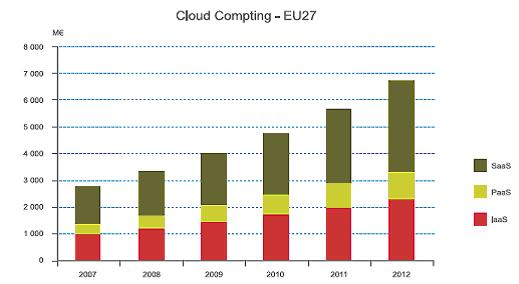
The analyst firm IDC believes the depressed economic climate will drive more enterprises to consider and adopt cloud-based services. They predict that spending on cloud services will hit $US42 billion by 2012 (Maitland 2009). Similarly, IDC estimates in that the market of cloud-based services amounted to 5% of 2009's worldwide ICT spending, representing $17 billion. Following a double-digit growth of 25% a year, this market could reach $44 billion in 2013, representing 10% of ICT spending worldwide. In Europe, the analyst firm PAC, commissioned by the European Commission (EC), estimates in that the cloud based services market amounted to 4 billion euros in 2009, representing 1.5% of the total software and ICT consulting industry. This number could grow to 13% by 2015.
Illustration 4: Cloud Computing Market Forecast in Million € for the EU's 27 Member States (Graphic Courtesy of Syntec - ©PAC )

In France, the research firm Markess International estimated the total cloud computing and server hosting services market to represent over 2.3 billion euros in 2009, and expects a steady growth in the SaaS and IaaS segments, which seems to be even more in the today's scenario. :-)